Introduction
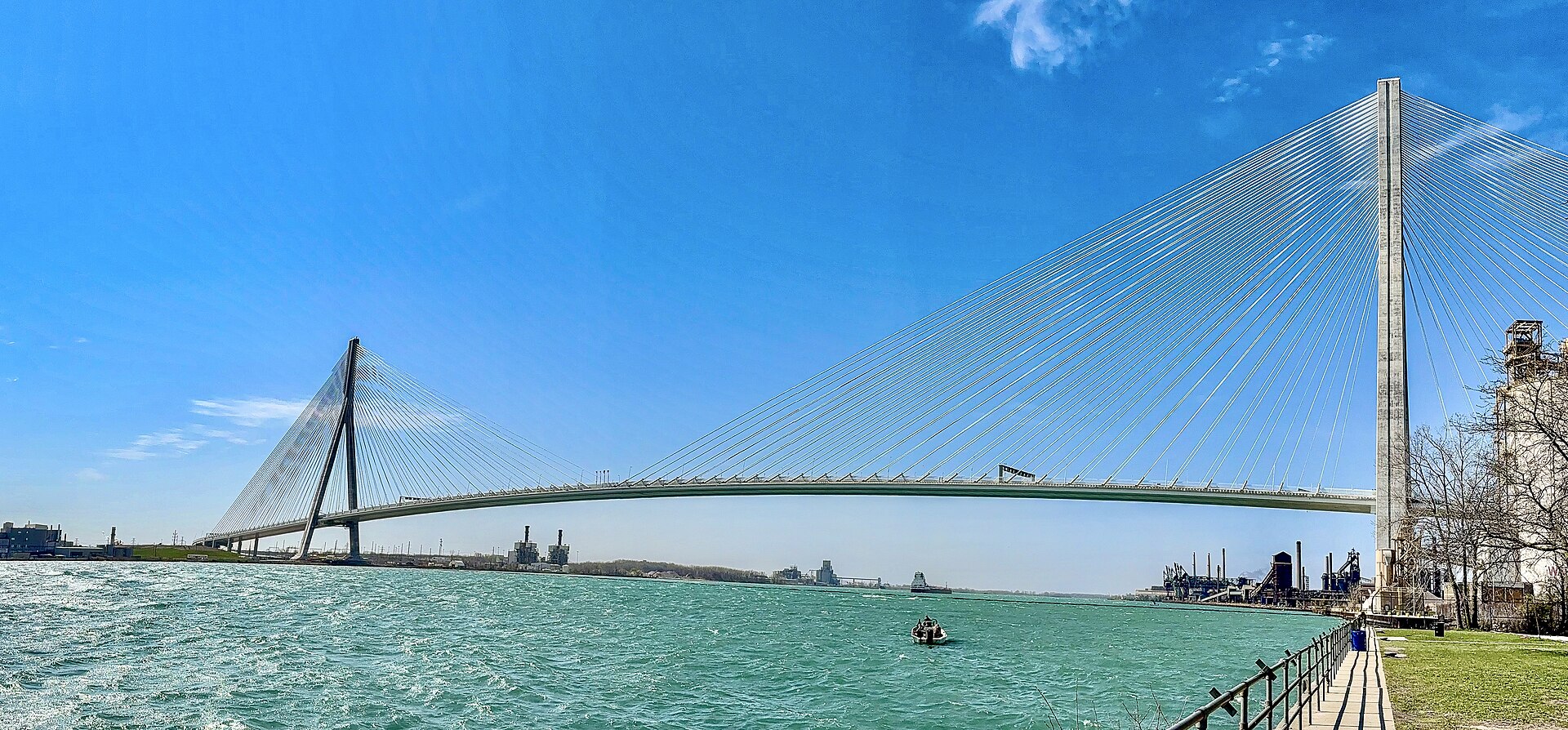
The Gordie Howe International Bridge (French: Pont International Gordie-Howe), previously known as the Detroit River International Crossing and the New International Trade Crossing, is an under-construction cable-stayed international bridge spanning the Detroit River and the U.S.-Canada Border. When the bridge opens to traffic sometime in 2026, it will provide a seamless connection between the City of Windsor, Ontario, Canada (via Highway 401), and the City of Detroit, Michigan, U.S.A. (via Interstate 75).
Overview
- Type of Bridge: Cable-Stayed Bridge
- Total Bridge Length: 2.5 kilometres
- Total Bridge Width: 37.5 meters @6 lanes
- Maximum Height: 220 metres
- Clearance Below: 46 metres
- Total Cost: CAD 6.4 billion (~USD 4.8 billion)
- Full Opening: 2026
- Owner & Developer: Publicly-Owned via Windsor-Detroit Bridge Authority (WBDA)
Need
The Gordie Howe International Bridge (GHIB) is a vital infrastructure project for the economic growth of both Canada and the United States of America. Designed primarily to facilitate heavy truck traffic between the two nations — 25% of which passes through the Windsor-Detroit corridor — the bridge will play a transformative role in enhancing trade efficiency.
Currently, the privately-owned Ambassador Bridge carries most of the cross-border truck traffic on this corridor. However, its lack of direct highway connection on the Canadian side and aging infrastructure have resulted in recurring maintenance challenges and traffic bottlenecks. Other cross-border connections across the Detroit River exist; however, due to their limitations,they are not regularly used for truck traffic.
According to the studies conducted in 2004, congestion on the Windsor-Detroit trade corridor was projected to cost the U.S. more than USD 2.2 billion yearly in lost production and output by 2020, while Canada would face losses exceeding CAD 300 million (~USD 200 million) per year. These impacts were expected to escalate sharply by 2030, reaching USD 11.4 billion/year for the U.S. and CAD 2.1 billion/year for Canada. Altogether, these impacts amount to total losses of about USD 40 billion between 2003 and 2020, rising by an additional USD 60 billion by 2030.
With the new crossing, several issues will be alleviated by easing congestion and ensuring smoother, more reliable commercial movement. Furthermore, since the overseeing authority is a public entity, the bridge will function as a national asset, generating long-term economic and operational benefits. On par in scale and ambition with landmark projects such as the Hong Kong–Zhuhai–Macau Bridge and the Atal Setu, the GHIB will be not only an engineering feat but also a strategic investment in regional and binational prosperity, reshaping the future of logistics across the Windsor–Detroit gateway.